
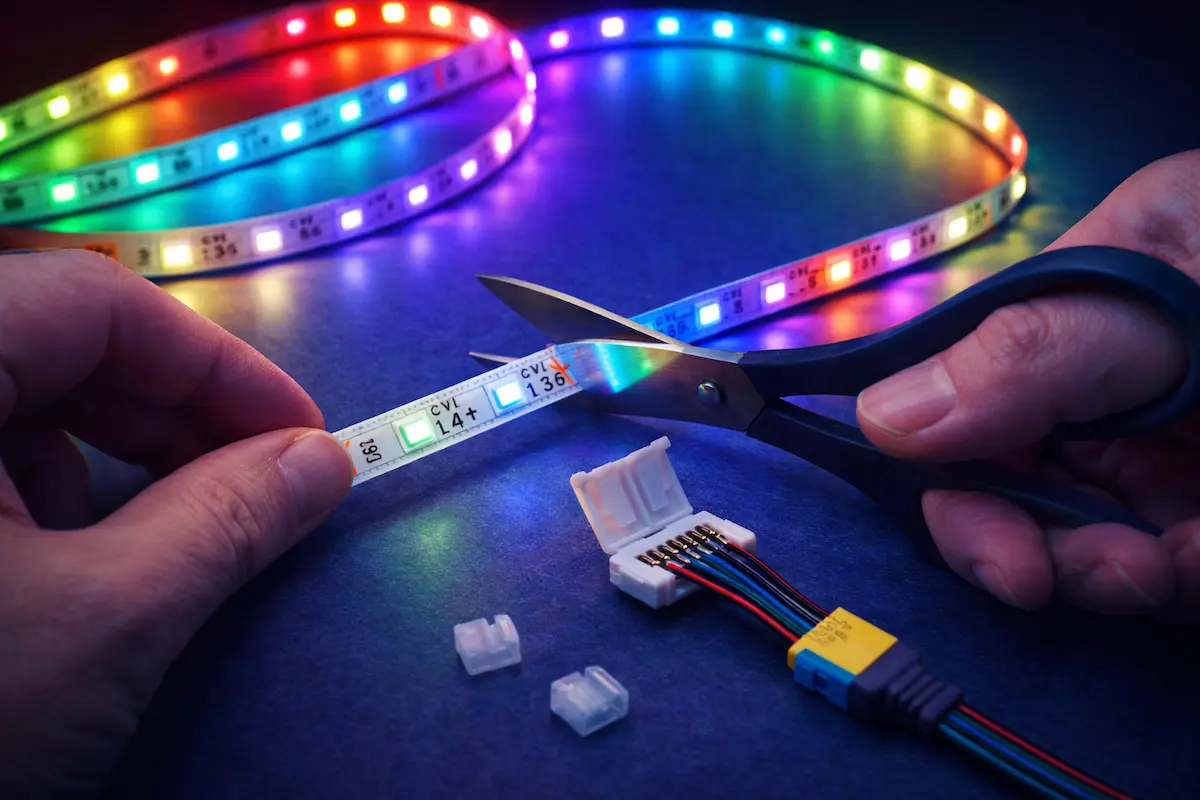
Let’s be honest: the idea of customizing your own lighting setup sounds amazing until you realize you might need a soldering iron and a steady hand. But here is the good news. You don’t need a degree in electrical engineering to get that high-end look. Whether you’re trying to wrap lights around a tight corner behind your TV or creating clean 90-degree angles under your kitchen cabinets, solderless connectors are about to become your best friend.
Here is how you get it done without the stress.
1. Find the Sweet Spot for Cutting
You can’t just take a pair of scissors to any part of an LED strip. If you do, you’ll break the circuit and end up with a dead section of lights. Look for the small copper pads spaced every few inches—they usually have a tiny scissor icon right next to them. This is the “safe zone.”
2. The Snip Grab a sharp pair of scissors. You want a single, clean, straight cut right down the center of those copper pads. Try not to let it be jagged. By cutting exactly in the middle, you leave enough copper on both sides for the connector to grab onto later.
3. Prep the Connector
Take your snap-on connector and flip open the plastic door. Before you slide anything in, double-check your polarity. Your LED strip will have little “+” and “-” signs (or RGB labels) on the copper. These must match the markings or wire colors on the connector. If you flip them, the lights simply won’t turn on.
4. Slide, Snap, and Lock If your LED strip has an adhesive backing, peel back just a tiny bit of the paper near the cut. Carefully slide the strip into the open connector.
The secret pro tip: Ensure the strip goes underneath the small metal teeth inside the clip, not over them. Those teeth need to bite into the copper pads to create a solid connection. Once everything is lined up, snap the plastic lid shut until you hear it click.
5. The Moment of Truth Always test your lights before you stick them to the wall. Plug them in. If the new section stays dark, don’t panic. Usually, the strip just shifted slightly. Just pop the connector back open, wiggle the strip to make sure the metal teeth are hitting the copper, and snap it shut again.